1 Aging infrastructure
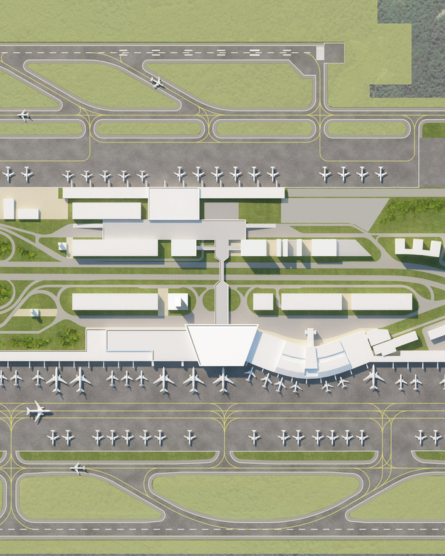
Most European airports still run on infrastructure built between 1970 and 1990. It is now so old that it will soon need fundamental replacement, at very high cost. And this replacement has to be planned so that flight operations can continue during construction. That makes these building projects extremely complicated.
2 Lack of space
Many established airports can no longer expand their perimeter. Space for necessary extensions must first be found within the existing infrastructure, often through complicated reshuffling of uses that can only be done in several phases. As a result, renewing infrastructure is much more complicated and expensive than it was in the past.
3 Staff shortages
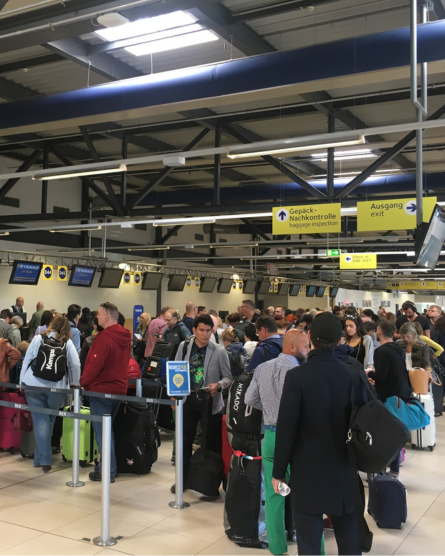
At most European airports this was already the case after Covid: many former ground handling staff left and now work in logistics centres, where they find better working conditions. In the long term there is a second problem. In Germany, for example, demographic change means that far fewer young people will be entering the job market. On average, the workforce will not only be smaller but also older. For physically demanding jobs at the airport, such as baggage handling, we therefore need much more automated solutions.
4 Need for sustainability
Airports cannot avoid making their huge building stock and their ground operations more sustainable and energy efficient. In the future, ground handling will be 100% electric, a large part of the electricity will come from solar, heating and cooling will come from geothermal boreholes, and all buildings will need much better insulation. For new buildings, an optimised CO₂ balance is a must.
5 Declining growth
Many European airports, especially small and mid-size ones, are no longer growing, or only at low single-digit rates. In the past, new infrastructure was financed by growth. In the future, airports will have to find another way.
6 Need for higher efficiency
All the points above have one thing in common: first of all, they cost a lot of money. Airports will only be able to manage this if they start to increase the efficiency of their processes significantly. The focus has to move away from “more traffic, more revenue” towards optimised and leaner processes.
7 Digitalisation as a top management priority
This will only work if much more time and money is invested in digitalisation. Digitalisation and automation can only succeed if airports are willing to rethink parts of their business processes fundamentally. Such a change is also a long-term project and a cultural change. It can only succeed if the airport’s top management keeps the topic in focus all the time. It cannot be delegated to the IT department.
8 Redesign processes
To automate processes successfully, you first have to redesign them. Airports have not managed this well so far. One reason is that several external partners must be involved (airlines, ground handling companies). Another is that national or even European regulations are affected very quickly.
9 Closer integrations with airport partner
The airport of the future can no longer be only a landlord renting out space. It will have to take over the integrated control of all ground processes. The closer the hub carrier, the ground handlers and the airport work together, and the more they use one shared data pool, the more efficient the whole airport system becomes.
10 Adapting the business model
In the end, redesigning processes will mean that the business models of airports and airlines have to change in some areas. Airlines will probably step back from ground processes and focus on flying. On the other hand, the profits from more efficient processes will also have to be shared differently, in favour of the airlines. Otherwise, they will have no reason to support the efficiency measures.
What does this mean for the future?
When I look at these ten points together, it becomes obvious that they are all linked to each other: Aging infrastructure, lack of space, staff shortages, sustainability, declining growth: each would be a big challenge on its own. Together they mean that airports can no longer look at infrastructure and process development separately. A new terminal will only be affordable if the processes inside it become leaner. And new processes will only work if the building supports them. Hardware and software must be planned together from the beginning.
This is also a marathon, not a sprint. Rethinking processes, renegotiating with partners, changing regulations, building during live operations: none of this happens withing months. In my experience, such demanding transformations only succeed with a holistic strategy and a strong vision behind them. Without that, the energy goes down after the first difficulties and the organisation falls back into old patterns. Top management must create this focus and keep it alive, year after year.
And maybe the most important point for me: the next decade will not be decided by who builds the biggest terminal. It will be decided by who dares to rethink how the airport actually works.